Winter vulnerability in the energy sector: how suppliers can identify customers before they reach crisis
Published: Aug 13, 2026
Energy
Plus key takeaways and actions from Ofgem’s Consumer Vulnerability Strategy: Progress Report
Ofgem’s new report is well-timed (or at least, isn’t too late) to make a tangible impact for customers this winter.
Winter vulnerability in the energy sector and increased pressure on household energy bills is, of course, predictable. However, the individual customers who will be affected are often difficult to identify in advance. They stay invisible until a missed payment, an unusually cold week or an unexpected expense pushes them into financial difficulty or self-disconnection.
And then there are also customers whose circumstances are not visible through payment or account data alone. They may be struggling with their health, experiencing a change in income, caring for someone else or choosing between heating and eating, or other essentials, without telling their supplier. Ofgem reports that in January 2026, over a quarter of domestic consumers who had fallen behind on their bills or run out of meter credit for affordability reasons had not been in contact with their supplier.
Ofgem’s latest Consumer Vulnerability Strategy: Progress Report (published 21 July 2026) highlights the ever-increasing importance of identifying these customers earlier. It recognises that suppliers are making progress. However, it also finds that vulnerability identification and affordability support remain inconsistent across the energy sector.
As energy suppliers prepare for winter 2026–27, the question needs to move on from how to respond when a customer reaches crisis point. Instead, vulnerable customer and collections teams should be asking:
- How do we identify more customers before they miss a payment/payments or before they miss meals to afford heating.
- How to we generate and evidence a positive outcome for them.
The affordability pressure point we know is coming
Domestic energy debt reached a historic high of £4.79 billion in the first quarter of 2026. At the end of 2025, around two million electricity customers and 1.6 million gas customers were in debt or arrears.
For prepayment customers, Ofgem reports that average prepayment-meter debt repayment periods reached 269 weeks for electricity and 276 weeks for gas by the end of 2025. Weekly repayment amounts had fallen to approximately £5, helping keep deductions more manageable, but potentially leaving customers carrying debt for more than five years. This highlights the importance of earlier engagement with customers, before debt escalates to a level where customers need long-term repayment plans. Something which so far has not been successful – the average arrears balance when a repayment plan was agreed increased from around £698 for electricity and £592 for gas in 2020 to £1,049 and £862 respectively in 2025.
A summer of heatwave after heatwave has provided reduced let up for those in fuel poverty and arrears, swapping the need to keep the house warm with the need to keep it cool. But winter remains a looming pressure point.
Of the total monetary value of gas Additional Support Credit provided during 2025, 42% was issued in January, February and December. That’s nearly half issued in the first quarter of the year.
Additional Support Credit can be vital for maintaining supply during acute financial difficulty. But emergency credit on its own does not address the circumstances that caused the customer to need it, nor does it reveal whether the financial difficulty is temporary, long-term or the underlying causes. Its use can again indicate that earlier opportunities for support may have been missed. But it can at least provide an opportunity for a supplier to ask the customer if they are okay, and decide on a longer-term support plan.
Bringing us back to the two key challenges for suppliers this winter:
- Intervene quickly enough to prevent customer harm and missed payments.
- Understand the customer’s circumstances well enough to offer an appropriate longer-term route to a positive outcome.
Account data can indicate difficulty, but not always explain it
Suppliers are already using behavioural and account-level signals to identify customers who may be struggling.
Ofgem highlights examples including:
- Repeat payment failures.
- Cancelled direct debits.
- Irregular top-up behaviour.
- Prolonged non-payment.
- Changes in energy consumption.
- Repeated customer contact.
- Smart-meter indicators of self-disconnection.
These signals can provide an important prompt for proactive engagement, but to create a positive outcome more detail is needed.
For example, an irregular top-up pattern may show that a household is struggling to maintain supply, but not whether that difficulty is caused by reduced income, illness, bereavement, caring responsibilities, an inaccessible meter or competing essential costs.
A cancelled direct debit may indicate emerging affordability problems, but it does not tell the supplier what repayment level would genuinely be sustainable.
How do you get this valuable information though? Especially when…
Too many struggling customers remain out of contact and out of repayment plans
Early identification is particularly difficult when customers do not contact their supplier or feel unable to disclose what is happening.
In January 2026, 28% of domestic consumers who had fallen behind on their bills or run out of meter credit for affordability reasons reported having no contact with their supplier.
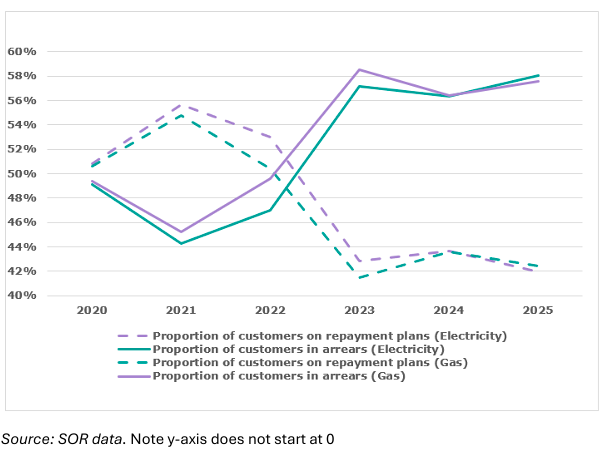
Linking to this, one of Ofgem’s central concerns is that too many customers in debt are not in a repayment plan. At the end of 2025, around 58% of consumers who were behind on their bills were in arrears without a repayment plan. A substantial increase from around 49% at the end of 2020. Without support that reflects ability to pay, these customers are unlikely to see their debt position improve. Ofgem explicitly states that “more needs to be done to move customers into sustainable repayment arrangements and joined-up support”.
This presents an important challenge for winter planning:
- The customers most at risk may not necessarily be those who call first, explain their situation clearly or ask for the right form of assistance.
- Some customers find telephone conversations difficult. Some may feel embarrassed. Others may not recognise their circumstances as vulnerability or know which information is relevant to share.
- Others will purposely avoid communications from their supplier due to fear relating to debts, mistrust or feelings of being overwhelmed by their situation.
Offering different routes to disclosure can help suppliers reach more customers.
Challenge 1: How to identify and support vulnerable customers before their situation escalates
A focused campaign to identify vulnerable customers needs to combine both account and usage data, location data, demographic data, and could include data from data sharing partnerships like Council Tax arrears data or DWP data.
Key groups to prioritise before winter
- Irregular or declining prepayment top-ups.
- Repeat Additional Support Credit requests, if these have been in summer they’ll likely increase during winter as heating needs increase.
- Recent self-disconnection indicators, same as above, these are likely to worsen in winter.
- Failed or cancelled payments.
- Emerging arrears, to try and get on top of before winter costs increase.
- Known medical dependence on energy and keeping warm in winter.
- Repeated contact without resolution.
- No recent successful engagement despite signs of difficulty.
These groups can also be layered with geographical and demographic data. Citizens Advice regularly hosts useful data tables on the key and overlapping issues they are supporting people with, which can be overlaid by household type. See latest Citizens Advice data.
In addition, newly released research from the Family Resources Survey by the University of York revealed that in 2024/25:
- Single-parent families,
- households with a disabled family member,
- and Black families bore the brunt of the energy debt crisis.
Arrears ran at 14.3% among single-parent families, more than three times the national rate. The figures also show 9.5% of Black, African, Caribbean and Black British households were in arrears, as were 6.6% of families with a disabled member, compared to just 1.9% where no one is disabled. Families with children were also far more likely to be in arrears than households without. (Source: University of York Social Policy Research Unit (Ana Castro and Jonathan Bradshaw), analysis of the Family Resources Survey 2024/25.)
These indicators can help identify a priority cohort. A wellbeing check can then help reveal what support each customer actually needs.
How to identify the customer’s unique circumstances to create positive outcomes
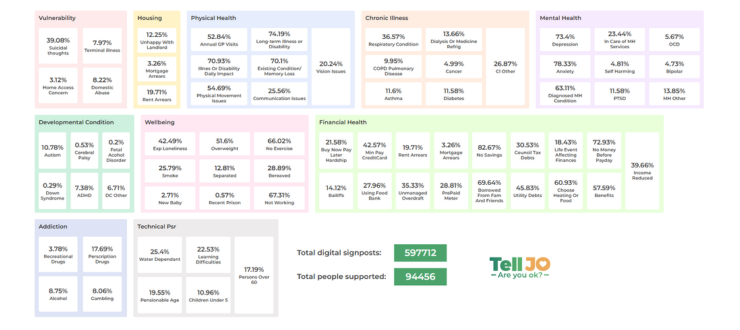
Ofgem’s report identifies digital assessments, app-based vulnerability tools and online self-service options as ways suppliers can make it easier for customers to share or update information. Digital tools can complement existing disclosure methods like staff-led conversations, data analysis, partnerships and proactive outreach, reaching those who wouldn’t traditionally engage. We’ve found customers are five times more likely to disclose via a third-party digital wellbeing check with TellJO than during a phone-call with their supplier.
Starting with a simple ‘Are you okay?’ rather than a reminder about missed payment or an action the customer needs to take, a digital wellbeing check can give customers a private, low-pressure way to explain:
- Their financial circumstances.
- Their physical or mental health.
- Changes in household income.
- Caring responsibilities.
- Difficulties accessing or using their meter.
- Whether they are going without heat, food or other essentials.
- Wider pressures affecting their ability to engage or pay.
This information can provide the context that account data cannot. It can help a supplier distinguish between a temporary payment problem and a more complex situation requiring specialist intervention, additional protections or wider support. See the data digital wellbeing checks provide.
Challenge 2: How to generate and evidence a positive outcome for the customer
Understanding vulnerability is step one. Step two is creating pathways to improve a customer’s situation.
For acute difficulty keeping a customer on supply is the immediate priority, and while that’s a measurable outcome, it’s often only a sticking plaster. Without a longer-term route, the same customer may return for further emergency assistance, continue to build debt or remain on an unaffordable repayment arrangement.
The Ofgem report found that around 58% of electricity and gas customers who were behind on their bills were in arrears without a repayment plan at the end of 2025. Unsurprisingly, customers outside structured repayment arrangements held larger negative balances.
A more complete winter-support pathway should connect early identification with an appropriate response. Depending on the customer, that could include:
- Immediate protection or emergency credit.
- Warm Home Discount or grant assistance.
- An affordability assessment.
- A revised repayment arrangement.
- Debt advice.
- Energy-efficiency support.
- Income maximisation support.
- Health, wellbeing or community support, through warm referrals to certain third sector organisations, including personalised signposts.
- Escalation to a specialist vulnerability team for one-to-one support.
The most effective intervention may not be a single action. It may be a coordinated series of steps based on the customer’s circumstances. This is only possible when you understand the bigger picture of a customer’s affordability issues.
Evidence of outcomes is becoming increasingly important
Ofgem’s direction is clear, suppliers will need to demonstrate not only what vulnerability processes they have in place, but whether those processes are improving outcomes.
The strongest examples identified in the report were those where suppliers could show a clear link between identifying need, taking timely action and achieving a better result for the customer. Ofgem specifically recommends strengthening evidence that support is improving customer outcomes rather than simply demonstrating that processes exist.
This means traditional activity measurement such as:
- The number of messages sent.
- The number of vulnerability flags added.
- The number of customers referred for support.
- The number of support credits provided.
Needs to expand to evidence:
- Previously unidentified needs being disclosed and any patterns among customer groups being linked to specific support initiatives.
- Customers being reached before crisis.
- Support being matched to individual circumstances.
- Movement into sustainable repayment arrangements, evidence of sustainability could come from wellbeing checks and repeated affordability assessments.
- Successful access to wider support.
- Reduced repeat reliance on short-term interventions.
- Improvements in customer confidence or wellbeing.
- The effectiveness of different outreach routes and cohorts and evidence of multiple options to access support. Based on the understanding that there is no one-fits-all solution, as different customers will have different communication needs and preferences.
TellJO’s own customer outcomes accelerator platform combines data from users completing a digital wellbeing check with outcome actions and customer replies to communication messages, allowing suppliers to bring together and track outcomes. Sending a wellbeing check at the start of a customer’s missed payment journey and then part-way through a payment arrangement is another effective way to track how customers’ situations have improved as a result of tailored support.
Start now before temperatures fall
August, September and early autumn provide an opportunity to:
- Define priority customer cohorts.
- Identify available warning signals.
- Test customer outreach.
- Capture wider circumstances.
- Establish escalation and referral pathways.
- Agree what outcomes will be monitored.
- Act before winter pressure peaks.
Our Winter Vulnerability Review is designed to help energy suppliers identify customers showing early signs of financial and wellbeing difficulty, understand what is preventing them from maintaining supply or making affordable payments, and connect them with appropriate support.
Find the customers who are likely to reach crisis this winter
Book a 30-minute Winter Vulnerability Review to discuss:
- Which customer groups may currently be missed.
- Which early-warning indicators could be used.
- How to connect short-term support with longer-term affordability.
- How to evidence the outcomes of a targeted winter intervention.
Book a Winter Vulnerability Review now – mention ‘Winter Vulnerability Review’ in the current objectives box.
Sources:
- Ofgem Consumer Vulnerability Strategy Progress Report, July 2026
- University of York Social Policy Research Unit (Ana Castro and Jonathan Bradshaw), analysis of the Family Resources Survey 2024/25 by End Fuel Poverty Coalition.