How Australian energy companies can support vulnerable customers and meet AER regulations
Published: Jul 17, 2025
Publications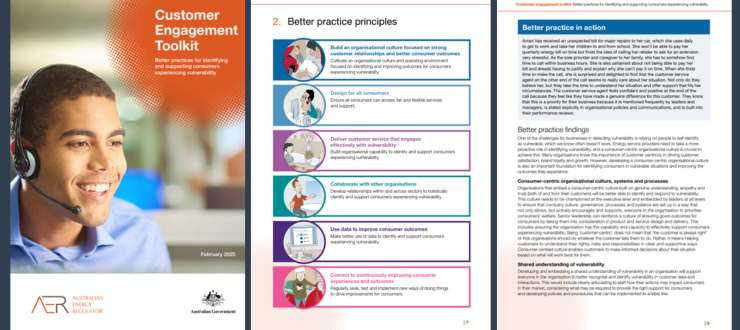
Australian energy companies are under increasing pressure to support customers facing financial or personal hardship. Customer teams are responsible not only for operational excellence but also for creating compassionate customer experiences that align with regulatory expectations.
With the launch of the Vulnerability Toolkit by the Australian Energy Regulator (AER) as part of action 2 in their ‘Towards Energy Equity’ strategy, energy retailers now have a best practice guide to identify and support vulnerable customers before financial stress or personal circumstances become a crisis.
In this article, we explore how to implement customer vulnerability strategies in energy retail, and what it means for your contact centre team, hardship processes, and collections operations.
What is the AER’s Vulnerability Toolkit?
Released in February 2025, the AER’s Customer Engagement Toolkit, commonly known as the Vulnerability Toolkit, is a central part of the Towards Energy Equity initiative. It outlines how energy retailers can:
- Identify vulnerable customers early
- Improve staff training and frontline response
- Develop tailored hardship solutions
- Shift from reactive to proactive customer care
Access the AER Vulnerability Toolkit
The toolkit highlights that vulnerability can affect anyone, either temporarily or long-term, and encourages companies to build systems and culture that reflect this reality.

How energy companies can put vulnerability guidance into practice
For most Australian energy customer support teams, the big question is not why to support vulnerable customers, but how. Here’s how you can apply the AER guidance in a practical, scalable way:
1. Early identification of vulnerable energy customers
Missed payments are often the last signal – not the first. Look for early indicators such as:
- A sudden drop in usage
- Change in communication patterns
- Calls or customer contact mentioning personal or financial distress, even if the customer is still paying their bills on time.
Digital tools like self-assessment surveys, wellbeing checks, and proactive email/SMS campaigns allow customers to disclose hardship privately and voluntarily. Through creating our digital wellbeing checks, TellJO has found customers are five times more likely to disclose digitally than through an in-person or phone conversation.
2. Train customer service agents for empathetic conversations
Empower your agents to:
- Recognise signs of hardship (emotional, financial, or situational)
- Ask safe, respectful questions
- Offer customers the chance to disclose their situation through a digital wellbeing check if they’d feel more comfortable, rather than having to speak to an agent about their situation
- Know when and how to escalate to hardship teams or which external support services are appropriate and can offer help
Investing in soft-skills training directly aligns with the AER’s recommendations and having a digital disclosure option reduces both agent and customer stress in having difficult conversations.
3. Redesign collections processes to be vulnerability-aware
Move away from transactional, ‘pay now’ scripts. Instead:
- Lead collections messaging with support – for example “We’re here to help” and “Are you okay?”
- Create flexible, customer-led repayment options – consider payment breaks or match re-payment schemes for those struggling. Several companies we work with in the UK simply write off bills/arrears for customers living with a terminal illness for example
- Measure success by customer outcomes and resolution, not speed
This approach improves outcomes and supports regulatory compliance with AER hardship obligations. Companies we’ve worked with have seen up to 1900% ROI through increased payment arrangements using these tips.

Why this matters: benefits beyond compliance
By aligning with the AER’s guidance and embedding the Vulnerability Toolkit into customer care, energy companies can:
- Improve customer outcomes, as customers feel seen, heard, and supported
- Reduce disconnections and complaints, as proactive care prevents crisis escalation
- Increase internal confidence, as staff have clear procedures and escalation pathways
- Demonstrate compliance with AER regulations, meaning less risk of audit issues or reputational damage
More importantly, energy customer care teams become a vital part of the solution to rising energy stress in Australia.
AER ‘Towards Energy Equity’: a call to action for energy retailers
The AER’s ‘Towards Energy Equity’ strategy is a sector-wide initiative to ensure energy remains fair, accessible, and supportive – especially for vulnerable consumers. Customer-facing teams, like customer service and collections teams are the frontline of this mission.
The Vulnerability Toolkit isn’t just another compliance document – it’s a blueprint for transforming energy customer support into a compassionate, consistent experience.
Final thoughts: leading with care and confidence
If you’re a Customer Support Manager or a Collections Manager in an Australian energy retailer, now is the time to:
- Review your hardship engagement process
- Embed early vulnerability detection systems and digital disclosure options
- Train your team with the AER Toolkit as a foundation
- Shift your collections approach from reactive to relational
By leading with care, you help your company stay ahead of regulatory expectations and deliver the kind of service customers will remember when it matters most.
Recommended Resources:
AER Vulnerability Toolkit – February 2025
Towards Energy Equity – AER Strategic Framework